Work / JabilWeb Global Intranet
Case Study — Enterprise UX

Building an intranet that served 50,000 employees for six years

A complete intranet redesign for one of the world's largest manufacturing companies — from a platform that frustrated employees daily to a trusted digital workplace that lasted more than twice the industry average lifespan.

Client Jabil Inc. (Fortune 150)
Timeline 2017–2018 Design & Launch · 2018–2024 In Production
My Role Lead UX Designer
Platform SharePoint · Custom Front-End
Key results
80% User satisfaction rating (4–5 out of 5)
14M+ Annual page views sustained year-over-year
43% Rated platform "Critical to my Work"
50K+ Employees served globally
6+ Yrs In production — double the industry average
The challenge

An outdated digital workplace holding back 50,000 employees

After an initial 2016 redesign showed promise but surfaced deeper structural problems, Jabil recognized the need for a complete intranet rebuild. The existing platform had become a barrier to productivity rather than an enabler — and with 50,000 employees across 100+ global locations depending on it daily, the cost of inaction was significant.

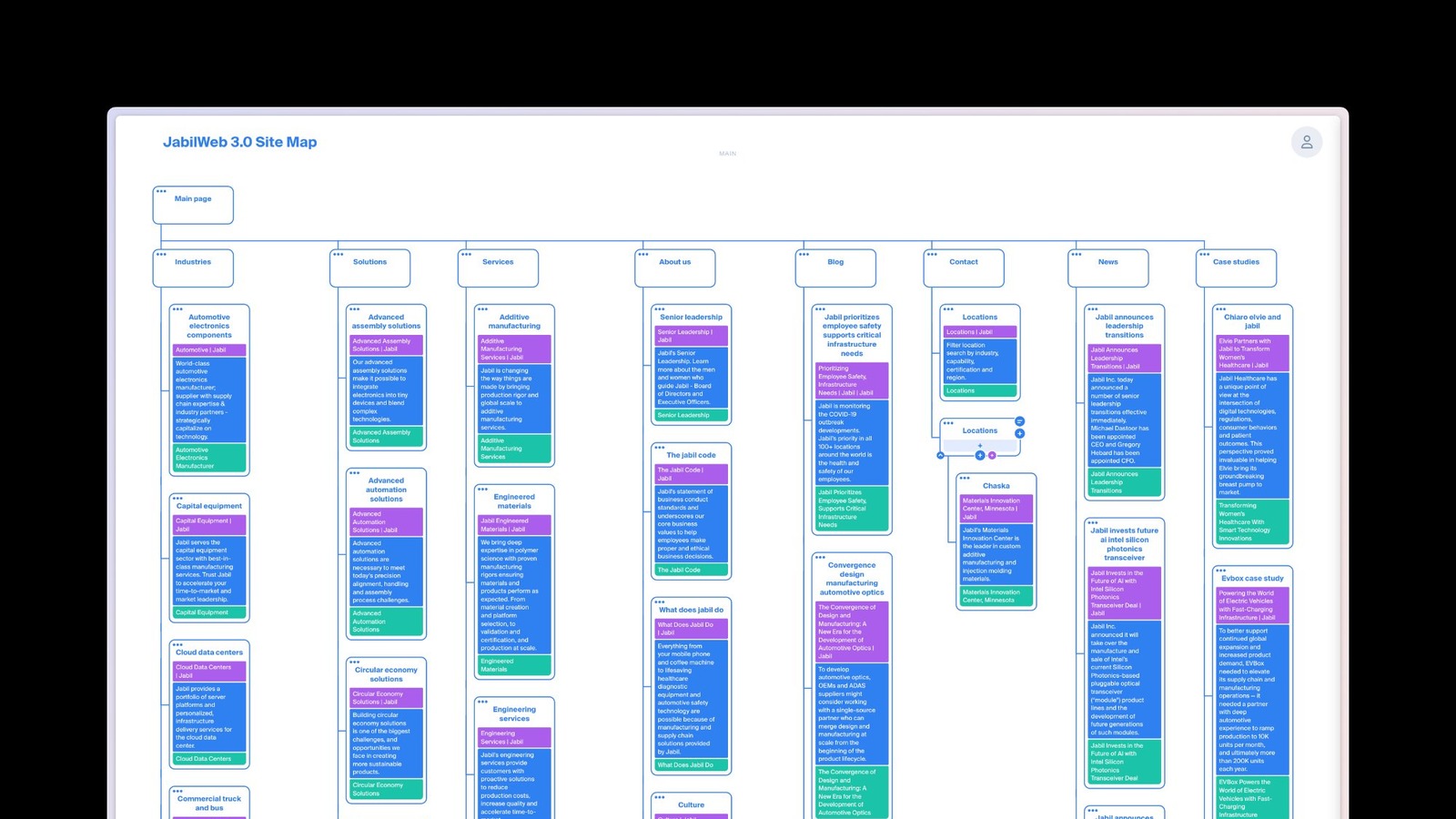
JabilWeb 3.0 site map showing full information architecture

User Experience Problems

  • Overwhelming navigation causing decision fatigue
  • Broken search that couldn't surface relevant content
  • One-size-fits-all content for vastly different roles
  • Critical tools buried 5+ clicks deep
  • Desktop-only design with no mobile access
  • Duplicate links scattered across multiple menus

Business Impact

  • "Where do I find X?" requests overwhelming IT & Comms
  • New hires struggling to locate essential information
  • No analytics on what employees actually needed
  • Multiple redundant systems causing daily confusion
  • Disconnected workforce unable to access culture content
  • Low engagement with the digital workplace overall

The core issue was philosophical: the intranet had been designed to broadcast corporate information, not help employees get work done. With user groups ranging from office workers to factory floor employees to global sales teams, a single undifferentiated experience wasn't serving anyone well.
The approach

Designing a digital workplace employees actually want to use

This project required balancing the needs of diverse employee groups while consolidating multiple legacy systems — all without disrupting daily operations for 50,000 users. I led the work through a structured five-phase process.

01 Discover

Understanding the real problem, not the assumed one

We conducted extensive employee interviews across multiple countries and departments, analyzed 12 months of intranet usage data and search queries, audited all existing systems slated for consolidation, and mapped workflows for key employee tasks — finding policies, accessing tools, checking benefits.

We also surveyed hundreds of employees on current pain points and wishlist features. This research phase was non-negotiable: we needed to understand what employees actually needed, not what stakeholders assumed they needed.

Key insights
  • On-the-go employees had zero access to critical information from mobile devices
  • Search was functionally broken — employees had stopped trying to use it
  • "I don't care about Finance news if I'm in HR" — personalization was a core need
  • Quick tool access mattered more to users than visual design quality
  • Regional needs varied significantly in language, cultural context, and local resources
02 Define

Setting the north star and making strategic bets

With research in hand, we created employee personas representing each primary user group, defined a content strategy around role-based personalization vs. broadcast content, and established the IA for system consolidation. We also built an engagement metrics dashboard from the ground up — because you can't improve what you can't measure.

Key decisions made
  • Mobile-first design to serve field and factory floor employees
  • Role-based homepage with personalized content and quick links
  • Search-first navigation with smart filters — not folder-drilling
  • Phased rollout starting with pilot departments to validate before scaling
  • Success metric defined: increase daily active users by 40%
03 Design

From wireframes to a tested, accessible design system

We moved from low-fidelity wireframes through interactive prototypes tested with employees representing different personas, to a high-fidelity visual design that modernized Jabil's brand for digital. Every design decision was grounded in a clear principle: personal, fast, clear, mobile-ready, and findable.

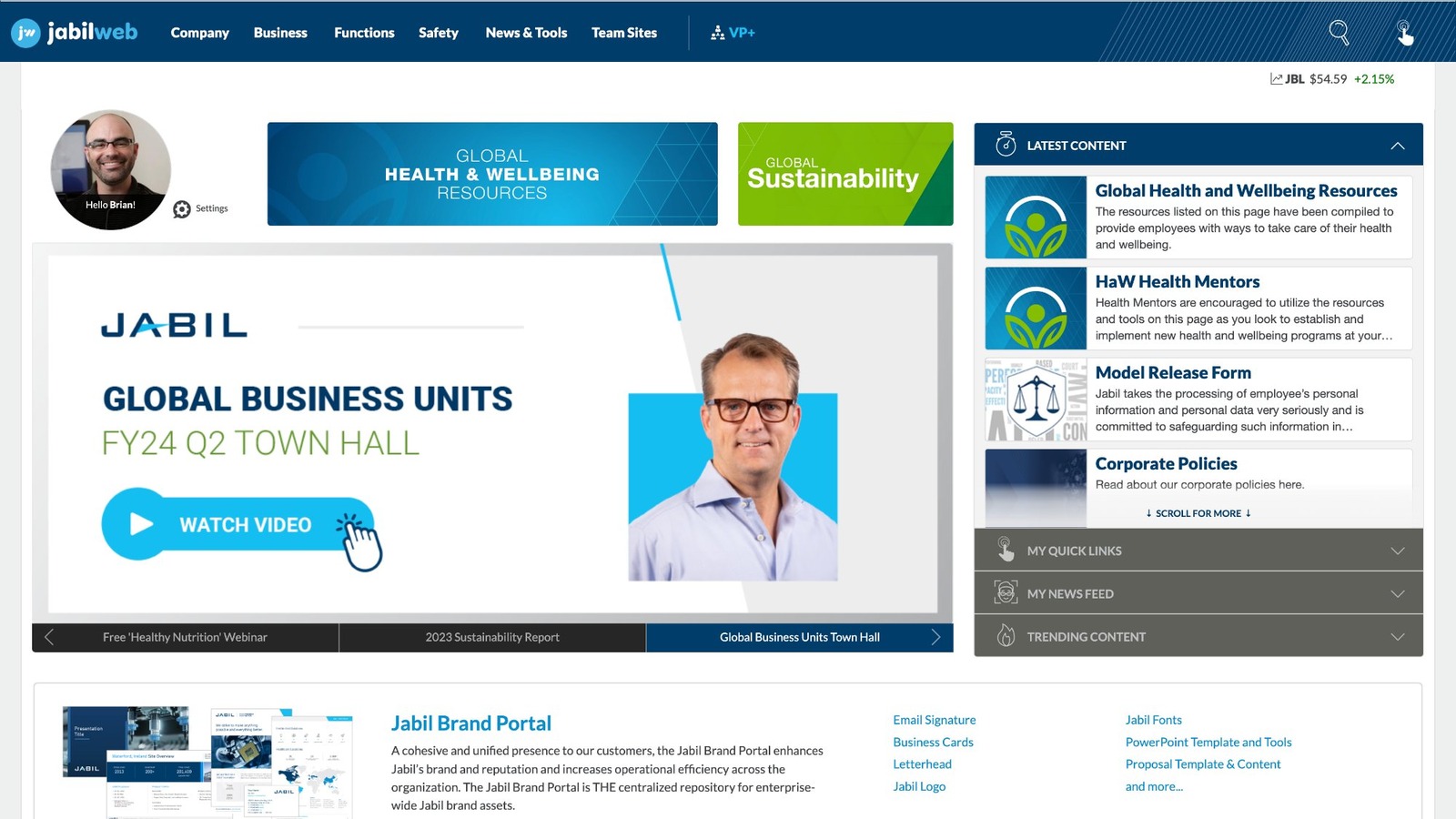
The homepage UX centered on a personalized Quick Links section (most-used tools per user), role-specific news, company-wide updates, and a prominent global search with autocomplete. An accessibility audit ensured WCAG 2.1 AA compliance throughout.

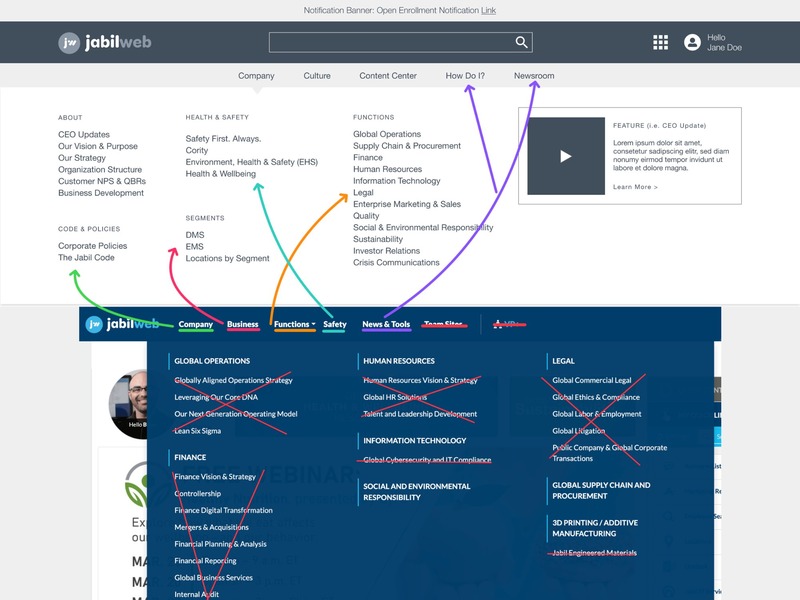
Navigation before/after comparison with design annotations
04 Develop

Staying engaged through build — not just handing off

I partnered with Jabil's internal development team and an external vendor throughout the build, running weekly design reviews and sprint planning. When technical constraints emerged — and they always do — we made smart compromises that preserved the user experience rather than sacrificing it for engineering convenience.

The platform migration from Optimizely CMS to SharePoint was the most complex technical challenge. We also navigated SSO/Okta OAuth integration, performance requirements for 50,000 concurrent global users, and role-based content personalization rules that had to work without extensive manual content tagging.

Notable compromises made
  • Simplified initial personalization rules — planned for post-launch enhancement
  • Deferred some advanced features to Phase 2 based on pilot feedback
  • Adjusted Workday and Okta sections to hard-coded links due to security constraints
  • Built extensive component variations to accommodate content creator needs discovered late
05 Deploy

A phased rollout designed to build momentum, not risk

We launched in carefully sequenced phases — starting with C-Suite and marketing leadership, expanding to project stakeholders, then department-wide, then four global regions, before the full enterprise rollout in early 2018. Each phase generated feedback that refined the experience before the next group onboarded.

Post-launch enhancements (2018–2024)
  • Added "Recently Viewed" and "Favorites" features by popular demand
  • Refined search filters based on real usage patterns
  • Built admin tools for the content governance team
  • Enhanced personalized content recommendations over time
  • Continuous optimization based on analytics and ongoing user feedback
The results

A platform that served the company for six years

The redesigned intranet launched in 2018 and continued serving Jabil until early 2024 — more than double the typical enterprise intranet lifecycle of 2–3 years. That longevity wasn't luck. It validated that the design was fundamentally sound, not just visually appealing.

User Satisfaction

  • 80% satisfaction rating (4–5 out of 5)
  • 76% rated user experience excellent
  • 43% deemed it "Critical to my Work"
  • Sustained satisfaction scores over multiple years

Engagement & Usage

  • 14M+ annual page views, tracked year-over-year
  • 50,000+ employees using the platform daily
  • Search transformed from "broken" to fast and accurate
  • 40% reduction in IT support tickets

Business Impact

  • Legacy systems consolidated into one platform
  • Improved onboarding experience for new hires
  • Enhanced internal communications reach
  • Design principles informed subsequent modernization
JabilWeb final platform — personalized homepage with quick links and latest content
What made this work

Four critical success factors

01

User-Centered Discovery That Challenged Assumptions

Rather than accepting stakeholder requests at face value, we interviewed employees across regions and roles. The insight that users wanted guidance — not just information — completely changed our approach and led directly to the "How Do I?" feature that became one of the most-used elements on the platform.

02

Flexible IA Built for Organizational Change

Jabil's structure changed frequently. Previous intranets broke every time departments reorganized. We designed an IA that separated content taxonomy from org structure, allowing the platform to adapt without major rework — contributing directly to its 6+ year lifespan.

03

Iterative Design with Real User Testing

Testing wireframes and prototypes with employees before development caught major usability issues early and cheaply. When users expressed concerns about search, we built an interactive HTML/CSS prototype to validate the approach — preventing what could have been a post-launch failure.

04

Balancing Consistency with Creator Flexibility

We created component variations that gave content owners creative freedom while maintaining UX integrity. This prevented the "everything looks the same" problem while avoiding the chaotic free-for-all that kills usability — and was critical to sustained adoption across departments.

Technical details

How it was built

Platform SharePoint with custom front-end (2018–2024) Migration Transitioned from Optimizely CMS to SharePoint (2017–2018) Users 50,000+ employees across 100+ global locations Integrations SSO, Active Directory, Workday (HR), ServiceNow (IT), Microsoft 365 Languages English, Spanish, Mandarin Chinese; select content in additional languages Accessibility WCAG 2.1 AA compliant Devices Primarily desktop (96%), with responsive design for mobile and tablet Longevity 6+ years in production (2018–2024)

Facing a similar intranet challenge?

Let's Talk